- ADDITIONAL MENU
- Aim and Scope
- Author Guidelines
- Peer Review Process
- Publication Ethics and
Malpractice Statement - Retraction, Withdrawal,
and Correction Policies - Plagiarism Policy
- Copyright and Licensing
- Publication Frequency
- Publication Fee
- Open Access Policy
- Archiving
- Revenue Sources, Advertising,
and Marketing - Generative AI Policies
Aim and Scope
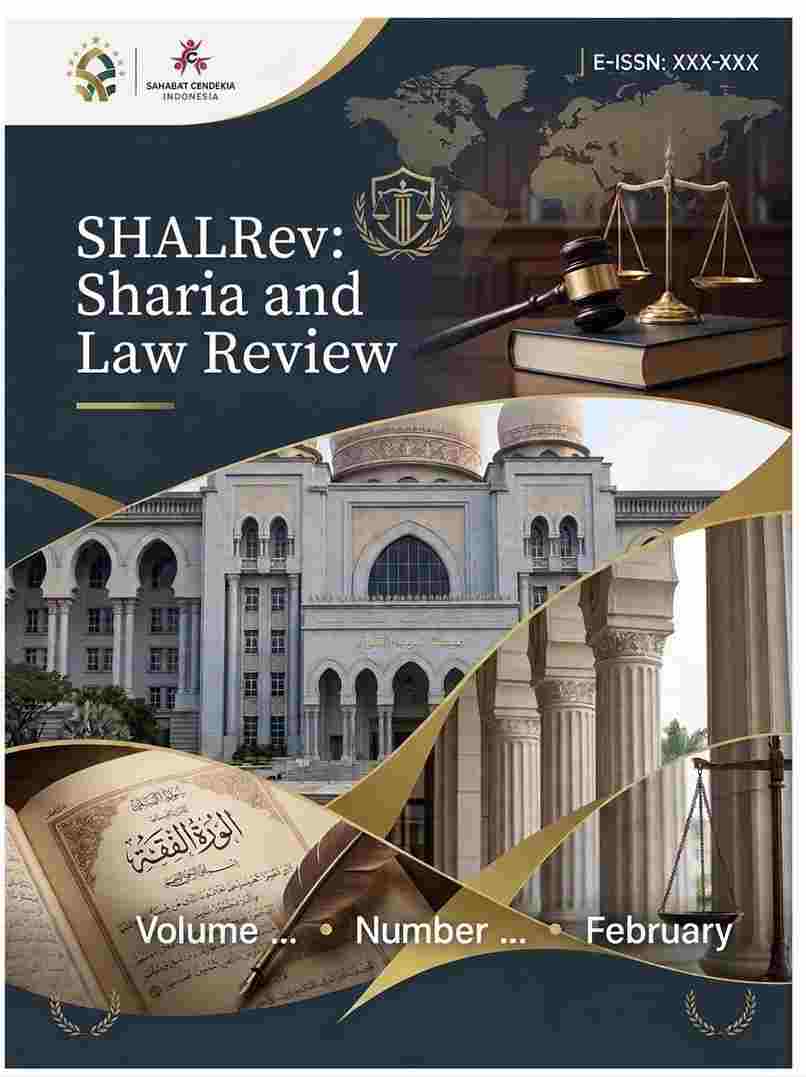
SHALRev: Sharia and Law Review is a scholarly journal dedicated to advancing academic discourse and research on Sharia, Islamic law, and contemporary legal studies, with particular attention to legal developments and socio-legal transformations in Southeast Asia and beyond. The journal welcomes theoretical, doctrinal, empirical, comparative, and interdisciplinary contributions that critically examine the relationship between Islamic legal traditions, national legal systems, customary law, international law, and contemporary legal institutions.
The journal covers, but is not limited to, the following areas:
- Sharia and Islamic Law: Islamic jurisprudence (fiqh), usul al-fiqh, maqasid al-Sharia, Islamic legal thought, and contemporary interpretations of Islamic law.
- Comparative Law and Legal Pluralism: Comparative legal studies, interactions between Islamic law, national law, customary law, and international legal frameworks, particularly in Southeast Asia.
- Contemporary Legal Developments: Legal reform, legislative developments, judicial practices, constitutional issues, and the transformation of legal institutions.
- Socio-Legal Studies: Relationships between law and society, including social change, legal culture, access to justice, and the implementation of law in diverse communities.
- Law, Governance, and Public Policy: Legal dimensions of public policy, institutional governance, regulatory frameworks, and state–society relations.
- Human Rights and Social Justice: Islamic perspectives on human rights, gender justice, equality, minority rights, religious freedom, and social inclusion.
- Interdisciplinary Legal Studies: Intersections of law with political, economic, cultural, technological, and environmental developments, including digital law, environmental law, and sustainable development.
SHALRev: Sharia and Law Review particularly encourages original research that offers evidence-based findings, critical perspectives, and innovative approaches to understanding contemporary legal challenges and contributing to legal reform, institutional development, public policy, and the promotion of justice in local, national, regional, and global contexts.